Are Ferrets Legal in New York? Legal Statewide, Banned in All Five NYC Boroughs (2026)
Ferrets are legal to own anywhere in New York State with no permit or license, and banned in all five New York City boroughs under Health Code 161.01(a)(4). Statute-cited, with the 1999 ban date and the 2015 Board of Health vote corrected.
- Published
- 23 July 2026
- Length
- 14 min read
- Section
- Guides
- Sourcing
- Primary statutes and agency rules
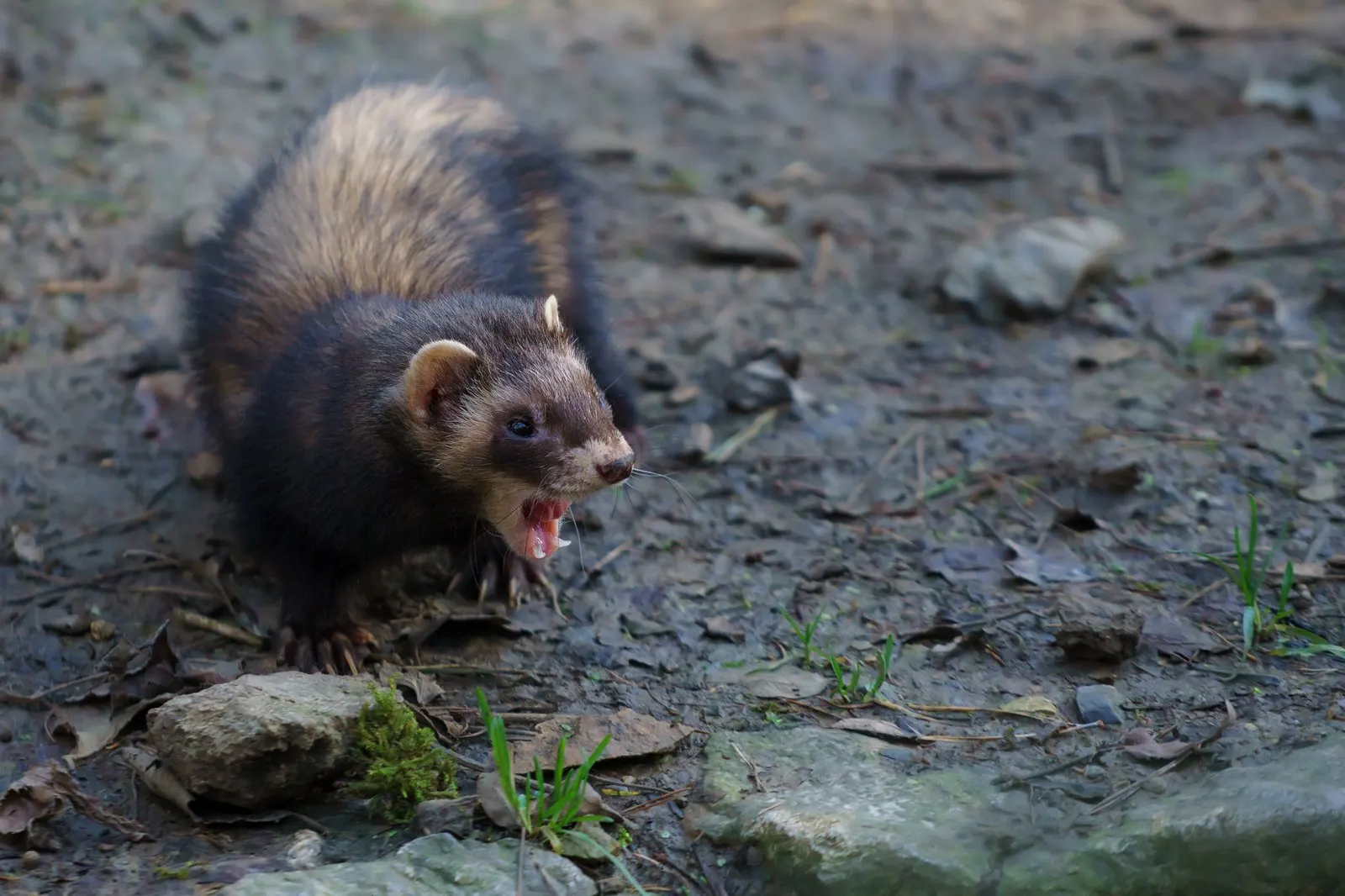
No state permit Domestic ferret ( Mustela putorius furo ) in New York
- Statewide status — Legal, unrestricted. Not on the ECL “wild animal” list (§ 11-0103(6)(e)) and not on DEC’s dangerous-animal list (6 NYCRR § 180.1(b)) — so no possession licence, no DEC permit, no registration.
- New York City status — Prohibited in all five boroughs — Manhattan, Brooklyn, Queens, the Bronx and Staten Island — under NYC Health Code
§ 161.01(a)(4), which bans “all fur bearing mammals of the family Mustelidae… and ferret.” - Pet permit in NYC? — None exists. Article 161’s only permit path is a Commissioner’s permit for a temporary exhibition, performance or display — not for keeping a pet.
- Required of every NY ferret owner — Rabies vaccination.
Pub. Health Law § 2141: first shot no later than four months of age, second within one year, then per label. Failure is a violation carrying a fine of up to $200 per offence. - NYC penalty — A Health Code Article 161 violation is answerable at OATH. Article 161 violations not separately scheduled carry $250, doubled on default, under 24 RCNY § 7-12 (effective 12 July 2025); the § 161.01 wild-animal entry has been reported at $500 ($1,000 on default) — verify the current Appendix 7-A schedule. Seizure of the animal is also possible.
- Last verified — 2026-07-24
The answer, by where you actually live
| Where | Status | Governing law | What it means in practice |
|---|---|---|---|
| New York State, outside NYC (Buffalo, Rochester, Syracuse, Albany, Long Island, Westchester…) | Legal — no permit | ECL § 11-0103(6)(e) · 6 NYCRR § 180.1(b) | Buy, own, breed, transport and sell freely. Only obligation is the rabies shot. |
| New York City — all five boroughs | Banned | NYC Health Code § 161.01(a)(4) | Cannot be kept, harboured, sold or given away. No pet permit exists. Complaint-driven enforcement. |
| Selling ferrets commercially in NY | Pet dealer licence | verify Agric. & Mkts. Law art. 26-A | The animal is unrestricted, but anyone selling animals at retail volume needs the state pet-dealer licence. Confirm thresholds with Ag & Markets. |
| Other NY city or village ordinances | verify local | Local ordinance | No other New York municipality is known to ban ferrets, but home-rule powers exist — a negative finding, not a guarantee. Check your village or town code. |
Why ferrets are legal in New York State: the proof, not the assertion
Most pages that answer this question simply assert “ferrets are legal in New York.” That is correct, but it is an absence — and an absence is only convincing if you can show which lists were checked. New York has exactly three places a ferret could have been restricted, and it appears on none of them. It appears by name on a fourth list that has the opposite effect.
| The list | What it covers | Ferret? |
|---|---|---|
ECL § 11-0512 — possession of wild animals as pets prohibited | Bans keeping a “wild animal” as a pet; fines up to $500 for a first offence and $1,000 for later ones, with a grandfather licence for animals held before the law took effect. | Not covered — the section borrows the definition below |
ECL § 11-0103(6)(e) — the definition of “wild animal” | The list “includes, and is limited to”: (1) nonhuman primates and prosimians, (2) Felidae and hybrids (other than the domestic cat), (3) Canidae (except domesticated dogs and captive-bred fennec foxes, Vulpes zerda), (4) Ursidae, (5) venomous reptiles, (6) Crocodylia. | Absent — Mustelidae is nowhere in the closed list |
6 NYCRR § 180.1(b) — DEC’s dangerous-animal regulation | Bars importing, possessing, selling or breeding listed live animals statewide; licences issue only for scientific, educational, exhibition, zoological or propagation purposes. The list expressly includes “skunks in the family mephitidae.” | Absent — the regulation never names Mustelidae or Mustela |
Pub. Health Law § 2141 — compulsory rabies vaccination | “Every dog, cat and domesticated ferret shall be actively immunized against rabies.” | Named — as a household pet |
That fourth line is the strongest evidence of all. New York State did not merely forget to ban ferrets; it wrote them into the same sentence as dogs and cats in the public-health statute that governs ordinary companion animals. A state that classified ferrets as wildlife would not require, and could not sensibly require, their owners to vaccinate them like a family dog.
Note the fennec fox carve-out in § 11-0103(6)(e)(3) while you are there: New York bans private canids generally but writes a captive-bred fennec exception into the statute — the same species that slips through the Texas rabies quarantine because it is African rather than North American. See our Texas exotic pet law hub for that contrast.
The New York City ban: the exact clause
New York City regulates animals through the New York City Health Code, a body of rules adopted by the city’s Board of Health — not by the City Council and not by Albany. Article 161 covers animals, and § 161.01 is titled “Wild and other animals prohibited.” Subdivision (a)(4) reads:
“All fur bearing mammals of the family Mustelidae, including, but not limited to, weasel, marten, mink, badger, ermine, skunk, otter, pole cat, zorille, wolverine, stoat and ferret.”
Two things are worth noticing. First, the ferret is not caught by implication or by a health department interpretation — it is named, in the text, at the end of a family-level listing. There is no argument that a domesticated Mustela putorius furo is somehow outside the clause. Second, the drafting is taxonomically old-fashioned: skunks are grouped into Mustelidae, though modern taxonomy places them in their own family, Mephitidae — the same drafting habit that puts skunks under Mustelidae in California’s restricted-species regulation. If you keep a skunk, our skunk legal states table covers that separately.
The prohibition applies to keeping, harbouring, selling and giving away, and it applies identically in Manhattan, Brooklyn, Queens, the Bronx and Staten Island. Article 161’s only permit route is a Commissioner’s permit allowing an otherwise-prohibited animal in a temporary exhibit, performance or display — a circus, a film shoot, a licensed wildlife educator. There has never been a pet category. If you want to understand how permit systems differ from outright bans, see our exotic pet permits explainer and the glossary.
- 5 boroughs covered — the ban has no geographic exceptions inside city limits
- 0 pet permits available for a ferret under Health Code Article 161
- 3–2 the 2015 Board of Health vote — in favour of lifting the ban, yet it still failed
Four things almost every page about NYC ferrets gets wrong
- “Ferrets have been banned in NYC since 1999.” The ban is far older than that. The 1999 date is repeated everywhere, and it is the wrong milestone. The Health Code’s wild-animal prohibition long predates it — reported as far back as 1959 — and the city was already prohibiting ferrets, and already litigating the prohibition, years before Rudy Giuliani’s famous radio outburst. In New York City Friends of Ferrets v. City of New York, 876 F. Supp. 529 (S.D.N.Y. 1995), a ferret-owners’ association challenged both the ban and the city’s policy of euthanising any ferret reported to have bitten a person; the court granted the city summary judgment, finding a rational relationship between the ban and a legitimate public-safety interest. What actually happened in June 1999 is narrower: the Board of Health, prompted by the Giuliani administration, voted to add ferrets to an explicit enumerated list of banned creatures — codifying an existing prohibition rather than creating one.
- “The Board of Health voted to keep the ban in 2015.” It voted to lift it — and lost anyway. In March 2015, under the de Blasio administration, the Board of Health considered a proposal to legalise pet ferrets subject to rabies vaccination, sterilisation and restraint outdoors. The vote was 3–2 in favour of lifting the ban, with four abstentions. It failed because the motion needed six votes on the eleven-member board. Nearly every article summarises this as the board “upholding” or “reaffirming” the ban, which implies a majority thought the ban was right. The record shows a majority of those who voted wanted it gone; the ban survived on a vote-threshold technicality and a bloc of abstentions.
- “The City Council could just legalise ferrets.” It tried, in 2001, and was vetoed. The Council passed a measure to legalise ferret ownership in 2001; Mayor Giuliani vetoed it, arguing ferrets are “naturally inclined to do harm.” Because the ban lives in the Health Code, the practical route to change is the appointed Board of Health, not the elected Council — which is exactly why two decades of advocacy has produced so little. Anyone lobbying for repeal should be lobbying the Board of Health and DOHMH.
- “New York State bans ferrets.” No — and the confusion costs people money. Because “New York” is used loosely for the city, out-of-state buyers and 50-state tables regularly mark the whole state as banned. The state’s own statutes say otherwise, and the practical consequence matters: a Yonkers or Mount Vernon resident is a few blocks from the city line and completely legal. Contrast California, which really is a statewide ban written into 14 CCR § 671.
Penalties and how the ban is actually enforced
Keeping a prohibited animal in New York City is a Health Code violation answerable at the Office of Administrative Trials and Hearings, not a criminal charge for the ordinary pet owner. DOHMH amended its penalty schedule effective 12 July 2025; the amendment added 24 RCNY § 7-12, setting $250 — doubled to $500 if the respondent defaults — for Article 161 violations not separately listed in Appendix 7-A. The specific § 161.01 wild-animal entry has been reported at $500, rising to $1,000 on default. We could not read the current Appendix 7-A line directly, so treat the exact figure as unconfirmed and check with DOHMH or OATH before relying on it.
The larger risk is not the fine. Enforcement is complaint-driven — a neighbour, a landlord, a building super or a 311 call — and the exposure comes at the moments when the animal becomes visible: a veterinary visit, a bite report, a housing dispute, a move. A prohibited animal can be seized. That, and not the dollar amount, is what NYC ferret owners describe as the real deterrent.
Rabies rules: the one place state and city law visibly diverge
Statewide, Pub. Health Law § 2141 requires every dog, cat and domesticated ferret to be immunised against rabies, with the first dose no later than four months of age and a second within one year. Owning an unvaccinated ferret is a violation carrying a fine of up to $200 per offence.
The bite rules matter more than owners expect. New York State Department of Health guidance treats the ferret as a domesticated animal for rabies purposes: a healthy dog, cat or ferret that has bitten a person should be confined and observed for ten days under the local health department’s direction, regardless of vaccination status — the same protocol used for dogs. That is a meaningful protection, and it is the opposite of the policy litigated in the 1995 Friends of Ferrets case, where a New York City ferret reported to have bitten someone was to be surrendered and destroyed for rabies testing.
We could not confirm from primary text whether New York City still applies an immediate-euthanasia policy to a biting ferret today, or whether DOHMH now follows the state’s ten-day observation guidance. Given that the animal is prohibited in the city to begin with, assume the worst-case outcome — surrender and testing — and verify with DOHMH before assuming a bite would be handled like a dog bite. This is precisely the kind of question where a confident wrong answer would be dangerous.
Moving into or out of New York City with a ferret
Unlike a pet skunk or raccoon — animals that many states bar from entering at all, as our raccoon legal states table details — a ferret faces no state import barrier in New York. You can move to Albany, Ithaca, Long Island or Westchester with your ferret and nothing changes except the rabies paperwork.
Moving into one of the five boroughs is the problem. There is no grandfather clause for pets already owned, no registration, no amnesty and no permit to apply for. The realistic options are rehoming the animal or living outside the city line. Passing through the city with a ferret in a carrier is not something the Health Code addresses explicitly, so treat transit as unresolved rather than safe.
Frequently asked questions
Are ferrets legal in New York State?
Yes. Ferrets are legal to own throughout New York State with no permit or licence. They are not on the closed “wild animal” list in ECL § 11-0103(6)(e), which § 11-0512 uses, and they are not on DEC’s dangerous-animal list at 6 NYCRR § 180.1(b). The only statewide obligation is rabies vaccination under Public Health Law § 2141, which names the “domesticated ferret” directly.
Are ferrets legal in NYC?
No. NYC Health Code § 161.01(a)(4) prohibits “all fur bearing mammals of the family Mustelidae,” naming the ferret explicitly, and the prohibition covers all five boroughs. There is no pet permit and no grandfathering. Article 161’s only permit path covers temporary exhibitions and performances.
Is Long Island or Westchester part of the ferret ban?
No. The ban is a New York City Health Code rule, so it stops at the city line. Nassau and Suffolk counties on Long Island, Westchester, Rockland and every upstate county follow state law, where ferrets are unrestricted. Brooklyn, Queens and Staten Island are New York City and are covered by the ban.
What happens if you get caught with a ferret in New York City?
It is a Health Code violation heard at OATH, not a criminal offence for a pet owner. Article 161 violations not separately scheduled carry $250, doubled on default, under 24 RCNY § 7-12; the § 161.01 entry has been reported at $500 (up to $1,000 on default) — confirm the current figure with DOHMH. The animal can also be seized. Enforcement is complaint-driven rather than proactive.
Will the NYC ferret ban be lifted?
Nothing is currently pending. The last serious attempt was the March 2015 Board of Health vote, which was 3–2 in favour of lifting the ban but failed for want of the six votes required, with four abstentions. Because the ban sits in the Health Code, repeal requires action by the Board of Health — a 2001 City Council bill to legalise ferrets was vetoed by the mayor, illustrating the limits of the legislative route.
Where else are ferrets banned?
California and Hawaii are the outright statewide bans; a handful of states require a permit; and New York City imposes a local ban in an otherwise permissive state — while Washington, D.C. expressly permits ferrets under D.C. Code § 8-1808(j)(1)(F), contrary to most published lists. Our 50-state ferret legality table gives the citation for every state. Browse the full matrix from our species index and state index.
Sources & verification
Every status above is pinned to the primary text below, except the two items flagged “verify” in the tables — the NYC Appendix 7-A penalty figure and New York’s pet-dealer licensing threshold. Last verified: 2026-07-24. Laws change; if you spot an error, tell us and see our editorial & sourcing policy.
- New York City Health Code, Article 161 (Animals) — § 161.01 “Wild and other animals prohibited,” subdivision (a)(4) covering the family Mustelidae and the ferret. nyc.gov (PDF). Primary regulation.
- N.Y. Environmental Conservation Law § 11-0103 — definitions, including the closed “wild animal” list at subdivision (6)(e). codes.findlaw.com. Primary statute.
- N.Y. Environmental Conservation Law § 11-0512 — possession, sale, transfer and import of wild animals as pets prohibited; penalties and grandfather licence. codes.findlaw.com · animallaw.info. Primary statute.
- 6 NYCRR § 180.1 — Animals dangerous to health or welfare (DEC’s prohibited list; skunks in the family Mephitidae listed, no mustelids). Cornell LII · NYSDEC dangerous animal list (PDF). Primary regulation.
- N.Y. Public Health Law § 2141 — compulsory rabies vaccination of “every dog, cat and domesticated ferret”; up to $200 fine. newyork.public.law. Primary statute.
- New York State Department of Health — ten-day confinement and observation guidance for domesticated animals including ferrets. health.ny.gov (PDF). State agency guidance.
- New York City Friends of Ferrets v. City of New York, 876 F. Supp. 529 (S.D.N.Y. 1995) — constitutional challenge to the ferret ban and the bite-euthanasia policy under Health Code §§ 161.01 and 11.65; summary judgment for the city. animallaw.info. Case law.
- NYC Rules — Amendment of Penalty Schedule for Violations of Certain Provisions of the Health Code (24 RCNY ch. 7, Appendix 7-A; new § 7-12 setting $250/$500 default for unlisted Article 161 violations), effective 12 July 2025. rules.cityofnewyork.us. Primary rule.
- NBC New York — “NYC Ban on Keeping Ferrets as Pets Stays, Health Board Rules” (March 2015 vote: 3–2 in favour, six votes required, four abstentions). nbcnewyork.com. Contemporaneous reporting.
- Slate — history of the ban: pre-existing wild-animal prohibition, the June 1999 Board of Health listing, and the 2001 City Council bill vetoed by Mayor Giuliani. slate.com. Secondary history.
Informational only — not legal advice. New York’s ferret rules split cleanly between state law (permissive) and one municipal code (prohibitive), and each can change independently. Two items on this page are explicitly unconfirmed against primary text: the current NYC Appendix 7-A penalty amount for § 161.01, and whether DOHMH now applies the state’s ten-day observation protocol to a biting ferret. Confirm both with the NYC Department of Health and Mental Hygiene, and confirm any local ordinance with your town or village clerk, before acting. Last verified: 2026-07-24.